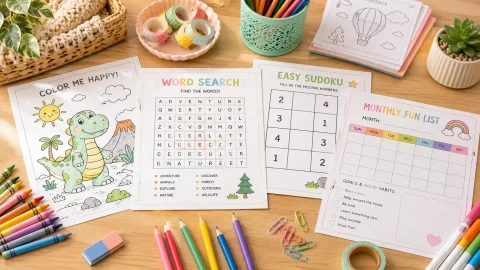
Classroom activities using printables work best when the task comes before the page. An independent center needs familiar directions; an early-finisher page needs a clear stopping point; a substitute activity needs enough explanation for another adult to use it.
The 25 classroom activities using printables below explain what to prepare, what students do, and what to look for afterward. These are activity ideas, not a download containing 25 worksheets. Choose tasks that match skills your students have already learned.
What's Inside
On this page
Set up classroom activities using printables with one tray
For the shape activities, use the basic-shapes sheet. It has separate circles, squares, triangles, rectangles, ovals, stars and hearts to observe and color. The wider Shapes collection offers other designs; check your chosen sheet before assigning a counting or naming task.
For number logic, choose a 4×4 puzzle from Beginner Sudoku with answers. Match the grid size and puzzle number to its answer sheet. Keep the solution with the adult, not on the student tray.
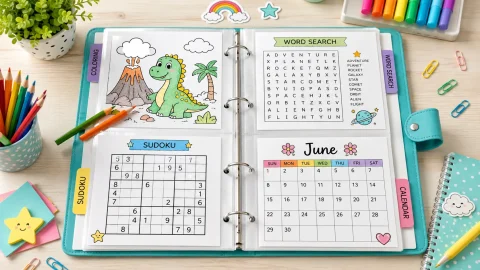
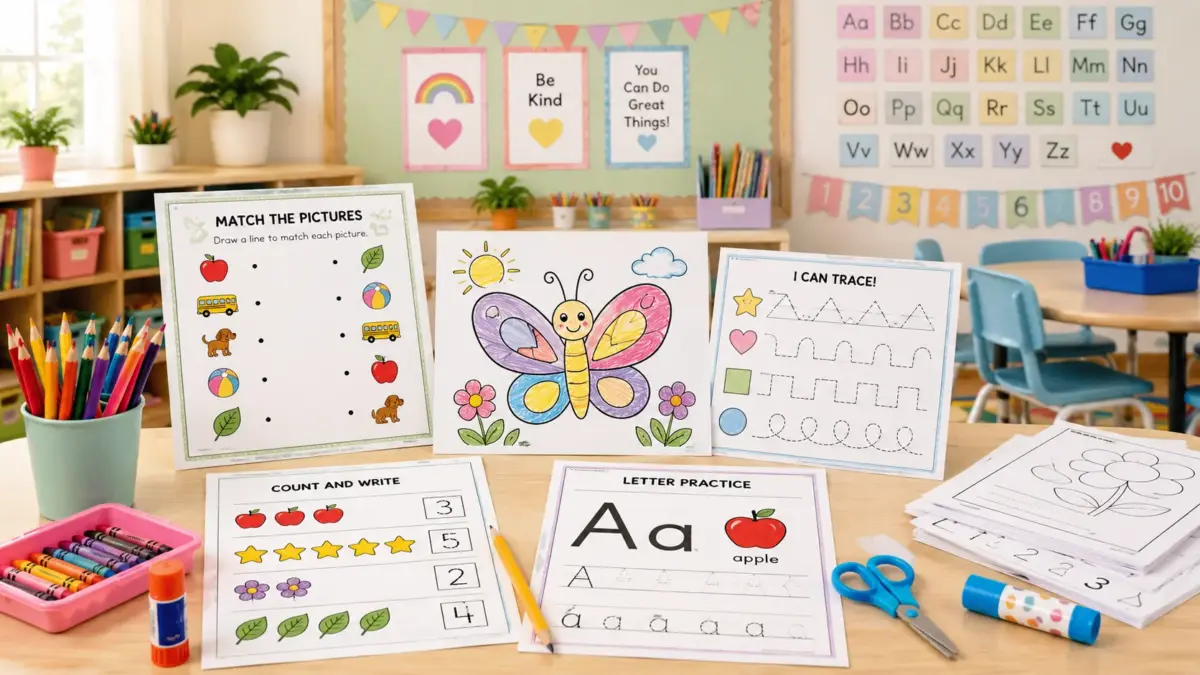
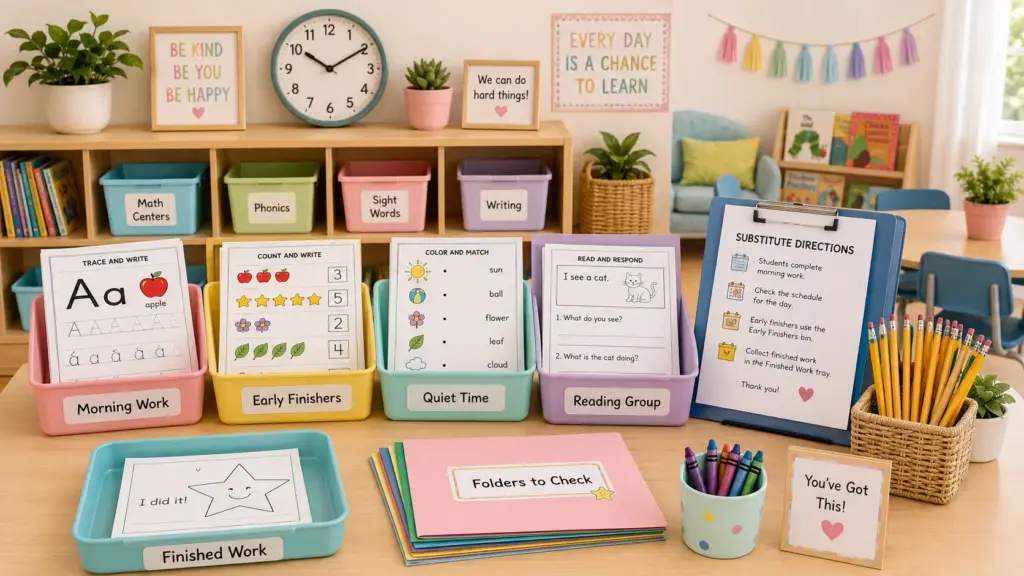
Put the chosen page, pencils or crayons, and one short direction together. A blank reverse side or separate scrap paper is enough for the writing extensions. Use a calendar page already available in class for the date activities; these ideas do not require a new worksheet for every task.
Choose classroom activities using printables with a clear finish point
The time ranges below are planning starting points, not measured completion times. A student may need less time, more support, a spoken response, or a second sitting. For each activity, show the direction once before expecting independent work.
Shape and number centers — allow about 5–10 minutes
- Find the matching pair. Give students the basic-shapes sheet and a crayon. Ask them to find two shapes with the same outline and color them alike. Have them point to the feature that matches. Stop after two pairs; the purpose is matching, not finishing every space.
- Straight or curved? On the same sheet, mark shapes with only straight edges in one color and shapes with only curved edges in another. Leave mixed-edge examples for discussion. Ask students to explain one choice rather than judging the whole page by neatness.
- Count the corners. Choose a triangle, square and rectangle on the page. Students point to each corner, count aloud, and write the total beside the shape. Check that they count each corner once. Do not use the stars or hearts for an introductory version of this task.
- Shape tally. Students choose one kind of shape, find every example on the sheet and make a tally on scrap paper. Compare the tally with the shapes they marked. A partner can check the count without giving the answer first.
- Pattern strip. Below the printed shapes, or on separate paper, draw circle–square–circle–square. Ask students to add four shapes and say the repeating part. For a challenge, let them make a new repeating pattern for a partner to continue.
Looking closely and using words — allow about 5–10 minutes
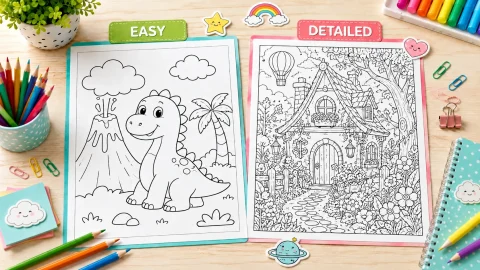
- Three-detail observation. Give students a chosen coloring page. Before coloring, ask them to point to or list three things actually shown. Check their descriptions against the image. A cloud in the picture counts; an imagined cloud belongs in a later drawing extension.
- Describe without naming. One student chooses a visible shape and gives two clues, such as “four equal sides” and “four corners.” A partner points to a match. Switch roles after one successful guess. Model accurate clues before making this an independent activity.
- Caption the picture. Students write one sentence explaining a visible scene on a coloring page. An adult can write a dictated sentence for an emerging writer. Check whether the sentence fits the picture; do not require a long story when one clear caption meets the task.
- Choose an action word. Ask students to find something in a picture that could move, then say or write a verb for it. Use the word in a sentence. If the page has only geometric shapes, choose a different image rather than forcing an animal or character activity onto it.
- Read and color. Write two directions that match the selected sheet, such as “Color one triangle blue” and “Leave one circle white.” Students follow them in order. Check the two requested actions, not the unassigned parts of the page.
Logic and explanation — allow about 8–15 minutes
- One missing number. On a familiar 4×4 Sudoku, students look for a row, column or outlined box with one empty square. They name the missing number and check the crossing groups before writing it. The finish point is one explained move, not necessarily the whole puzzle.
- Partner puzzle check. After a Sudoku attempt, partners check one row at a time for repeated numbers. They mark a row only after agreeing it follows the rule. Keep the answer key separate until they have checked their own reasoning.
- Explain a choice. Students select one number they entered in a Sudoku and complete: “This number fits because…”. Accept pointing and spoken explanation. Look for reference to a row, column or box rather than “because the answer page says so.”
- Make a clue. On scrap paper, students draw a row containing three different numbers from 1–4 and one blank. A partner fills the missing number. Explain that this is a single-row warm-up, not a complete Sudoku with a verified solution.
- Spot the duplicate. Write a sample row such as 1, 2, 2, 4 beside a blank space. Ask students what is repeated and what is missing if the rule is to use 1–4 once. Let them propose a correction, then apply the check to a real puzzle row.
Early finishers — allow about 5–15 minutes
- Two-color plan. Before coloring a selected picture, students choose two colors and explain where each will go. They can leave the background white. The task is to make and follow a plan, not to use every crayon or fill every detail.
- Pattern designer. Students choose one large open shape and add a repeating pattern inside it. Use a copy rather than the master. Ask them to point out the repeating unit afterward; adding a border or dots is optional, not required decoration.
- Picture questions. Students write or dictate two questions about a chosen image: one answerable by looking, one inviting imagination. For a turtle scene, these might concern the visible setting and where the turtle will go next. Keep observation and invention distinct.
- Add a setting. On the back of a coloring page, students draw a place where the subject might belong. They label one detail linking the new setting to the original subject. If the subject is imaginary, make that part of the creative prompt rather than a factual claim.
- Choose, finish, return. Offer two sheets with a familiar task. Students choose one, complete the agreed portion, and return supplies to a labeled place. A whole page need not be finished. Check the choice and cleanup routine as well as the work.
Transitions and substitute folders — allow about 3–8 minutes
- Find today's date. On the classroom's current calendar, students locate today and mark the next school day. Check the printed month and year first. If a weekend or closure intervenes, use it as a discussion rather than assuming the next number is a school day.
- Plan one task. Students choose one day on a calendar and add a short reminder or symbol. Ask them to explain it to a partner. The purpose is to connect a plan to a date; a calendar does not need to become a fully decorated art project.
- One-page recap. After another printable activity, students complete “I tried…” and “Next time…”. Accept a drawing or spoken response. Use their answer to choose the next activity, not as evidence that the printable produced a particular learning gain.
- Supply checklist. Beside the next task, list its actual supplies. Students check that they have the page, pencil and any required colors before starting. Avoid asking for tools the activity does not use. Return the checklist to the tray for the next group.
- Substitute-ready directions. Prepare one familiar printable with three written steps and a visible finish point. Students follow it, then tell the adult which step was unclear. Keep an answer or reference copy in the substitute folder when the activity has one correct result.
Adapt classroom activities using printables to different response modes
A student who can identify a shape but cannot yet write its name can point, say the word, or dictate. A confident writer can explain how two shapes differ. Keep the same core question so the extra writing is purposeful rather than simply more work.
The CAST Universal Design for Learning Guidelines recommend offering multiple ways for learners to act and express what they know. Use that principle to choose a response that fits the task—pointing, speaking, drawing or writing—without changing the learning goal.
For an independent center, choose a task students already recognize. Introduce unfamiliar Sudoku rules or vocabulary in a supported group first. If several students need repeated explanations, shorten the direction or change the task before printing another class set.
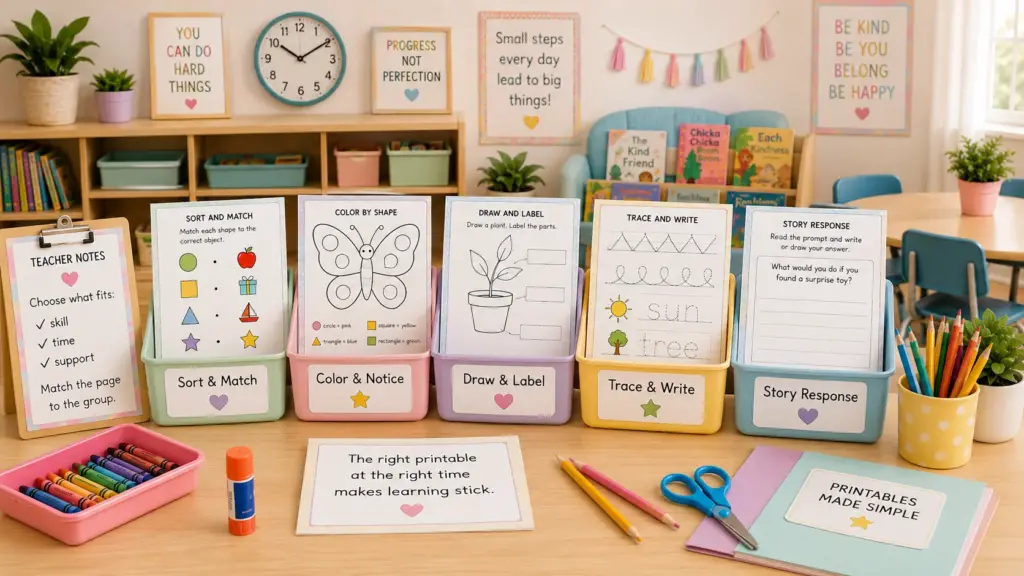
A quick check before making copies
- Confirm the selected sheet actually contains the shapes, subject or puzzle the direction names.
- Print one page and check that outlines, small numbers and the footer are visible.
- Decide whether students stop after one section or continue later.
- Keep solution pages separate and label them with the matching puzzle.
- Tell students what will be checked: a count, a sentence, an explained move or a completed routine.
To spread a small selection across the week, use the five-day morning-work routine. To store reusable masters and keep answers out of student sections, follow the activity-binder setup guide.
For classroom activities using printables, start with one tray and one task. Note which direction needs explaining and how much time your group actually uses before expanding the selection.