Easy vs. detailed coloring pages serve different goals. Choose an easy coloring page when you want large open spaces and fewer small decisions. Choose a detailed page when you want repeated patterns, small sections or a project you can return to. Neither choice is a test of age or ability: an adult may prefer a simple page, and a child may enjoy an intricate one.
When comparing easy vs. detailed coloring pages, look at the marks on the page instead of relying only on labels. Here are two existing ColoringGrid printables that show the difference.
What's Inside
On this page
Compare easy vs. detailed coloring pages using two real examples
The basic-shapes sheet has 11 separate outlines with generous white space between them. It includes a circle, a square, a triangle, a rectangle, two ovals, two stars, two hearts and a tilted square. Each outline contains a broad unpatterned area. Open the basic-shapes PDF.
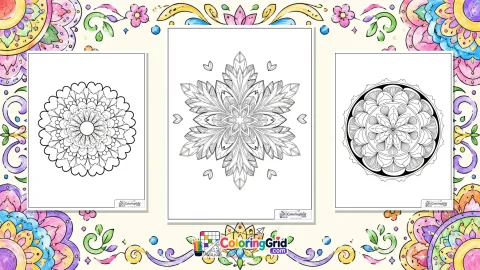
The detailed mandala sheet has a large central rosette, overlapping decorative bands, partial circles near the edges, and many small curved motifs. The design occupies most of the page inside its border. Open the detailed mandala PDF.
Both come from the existing Shapes coloring collection. They are separate single-page PDFs, not a new combined pack. This easy vs. detailed coloring pages comparison describes these two designs; it is not a timed coloring experiment.
| What to compare | Basic-shapes example | Detailed mandala example |
|---|---|---|
| Separation | Individual shapes with white space between them | Closely packed motifs and overlapping decorative bands |
| Small sections | Few; most outlines enclose one open area | Many narrow petals, curves and repeated details |
| Starting point | Pick any one shape | Pick the center, one ring or an edge section |
| Useful tool choice | A broad crayon or pencil can cover open areas | A sharpened pencil can reach smaller sections |
| Manageable finish point | One shape or one row of shapes | One ring, one motif or a selected portion |
A page-choice check before printing
Look at the smallest section you actually want to color, not only the largest picture. Compare it with the tip of the tool you plan to use. If the small sections feel cramped, choose broader spaces or decide to color across several sections as one area.
Then ask three practical questions:
- What kind of activity do I want? For a quick start, choose a page with an obvious small stopping point. For repeated pattern choices, choose a design with details you enjoy looking at.
- Do I want to finish today? A detailed page can be used over several sessions. A simple page can also take a long time if you add shading or your own patterns. Complexity does not supply a reliable completion time.
- Can I comfortably distinguish the outlines? Open the full-size file rather than judging a small thumbnail. If the detail is difficult to see, choose larger spaces instead of expecting the printed page to solve the problem.
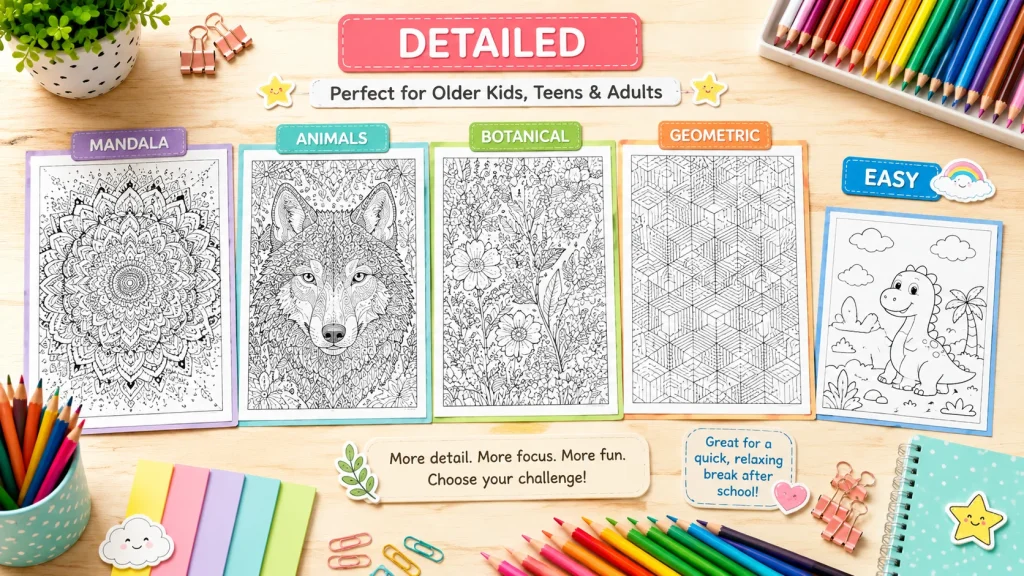
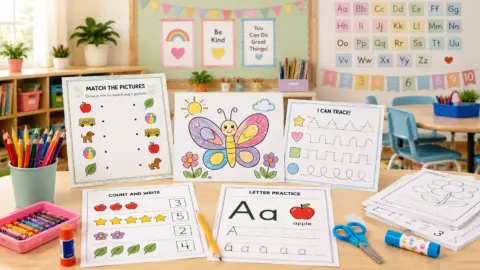
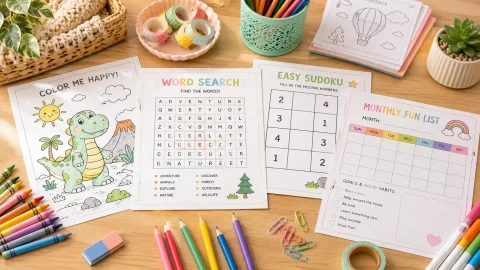
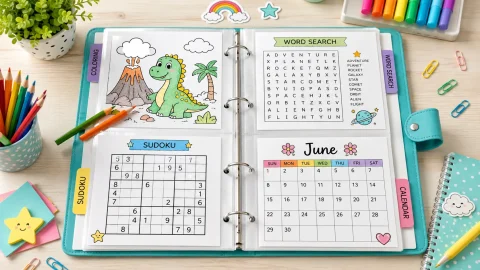
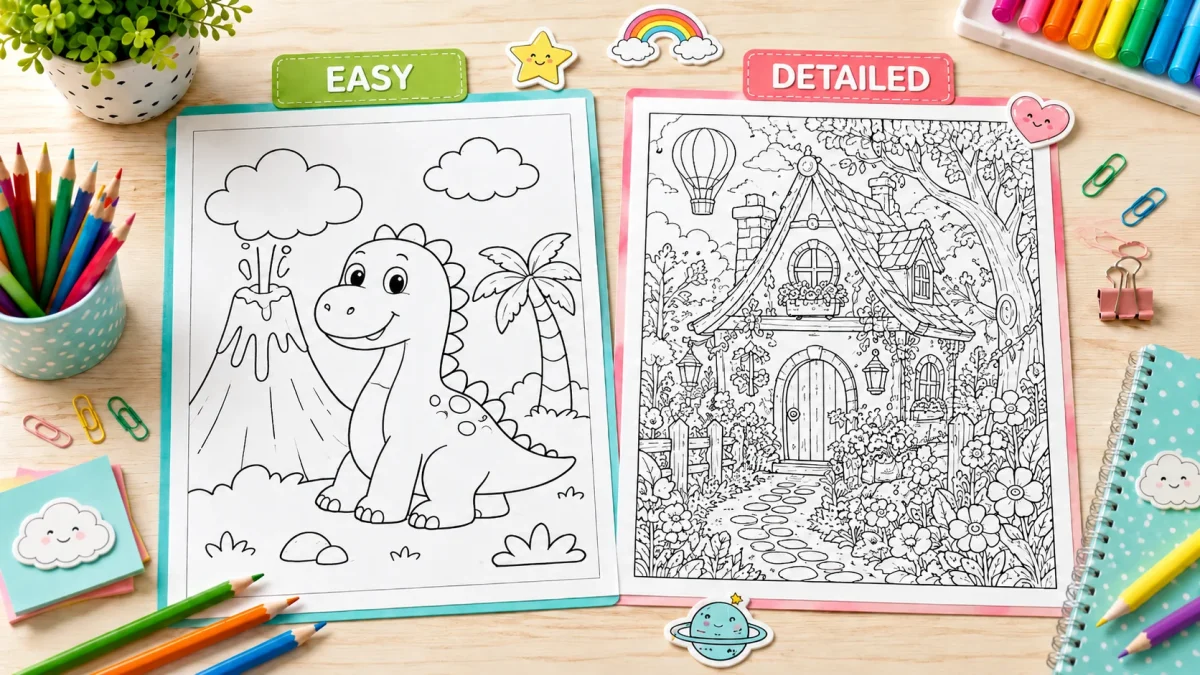
The illustrations on this page show general style ideas; the two downloadable examples described above are separate sheets. The age suggestions in the illustration are not requirements for choosing either style.
Match the page to the tools already available
The National Gallery of Art explains how light and heavy pencil pressure can change tone and texture. Use that idea as an optional technique: broad open areas can take layered pressure, while small sections may be easier with a sharpened pencil and lighter marks.
On the basic-shapes example, try using the side of a crayon to fill one large shape, then use its tip around the edge. The page leaves room to compare marks without needing a complicated palette.
On the mandala example, start with one small repeated motif and a sharpened colored pencil. Repeat the same color in nearby matching shapes if you want fewer decisions. You do not have to assign a different color to every enclosed section.
Markers need a paper check whichever design you choose. Test a small area on a spare sheet of the same paper and inspect the reverse before coloring over another page. The printable design alone does not establish whether a marker will bleed through. No particular paper-and-marker combination has been tested for this comparison.
Try one design in three different ways
The same page can support different tasks. On the basic-shapes sheet, choose one of these:
- Fill three shapes with one color each and stop.
- Use two shades inside one shape to experiment with a light and dark area.
- Add your own stripes or dots inside a large outline.
On the mandala, try one ring instead of the whole sheet, limit the palette to three colors, or leave alternate areas white. These are ways to control the task without changing the original printable. A partly colored page can still be a finished activity if it meets the goal you chose.
Choosing easy vs. detailed coloring pages for a group
Offer a small choice based on visible features: “separate large shapes” or “many small patterns.” Avoid treating a detailed page as a reward or a simple page as a lower achievement. Subject interest matters too; a favorite animal with some detail may be more appealing than an unrelated simple design.
For a short group session, explain the stopping point before handing out pages. One person might finish three large shapes while another colors one mandala ring. Both can stop at the same time without having to fill the entire sheet.
If you are selecting a classroom task rather than an open coloring session, use the printable classroom activity guide for observation, matching and pattern prompts. Its directions can be shortened or answered aloud when writing is not the purpose.
Print the detail without shrinking it away
Open the PDF and inspect the print preview. Check that the border and footer fit within your printer's printable area. Use a fitting option if needed, but avoid putting several detailed sheets onto one small page unless you are comfortable with the smaller sections.
For a fair easy vs. detailed coloring pages comparison, print the two examples at a similar scale and offer the same tools. Try a small section of each, then ask which experience you prefer today. The goal when choosing easy vs. detailed coloring pages is a comfortable activity, not a standardized assessment, and there is no need to score the result.
Are easy vs. detailed coloring pages age-specific?
No. “Detailed” describes the design. Let interest, comfort with the visible sections and the available tools guide the choice rather than a strict age cutoff.
Does an easy page have to be finished quickly?
No. Large spaces can support shading, added patterns or slow experimentation. A simple outline does not require a simple color treatment.
Can I use just part of a detailed page?
Yes. Choose one ring, motif or area before starting. Leave the rest white or return to it another day; completing every section is optional.