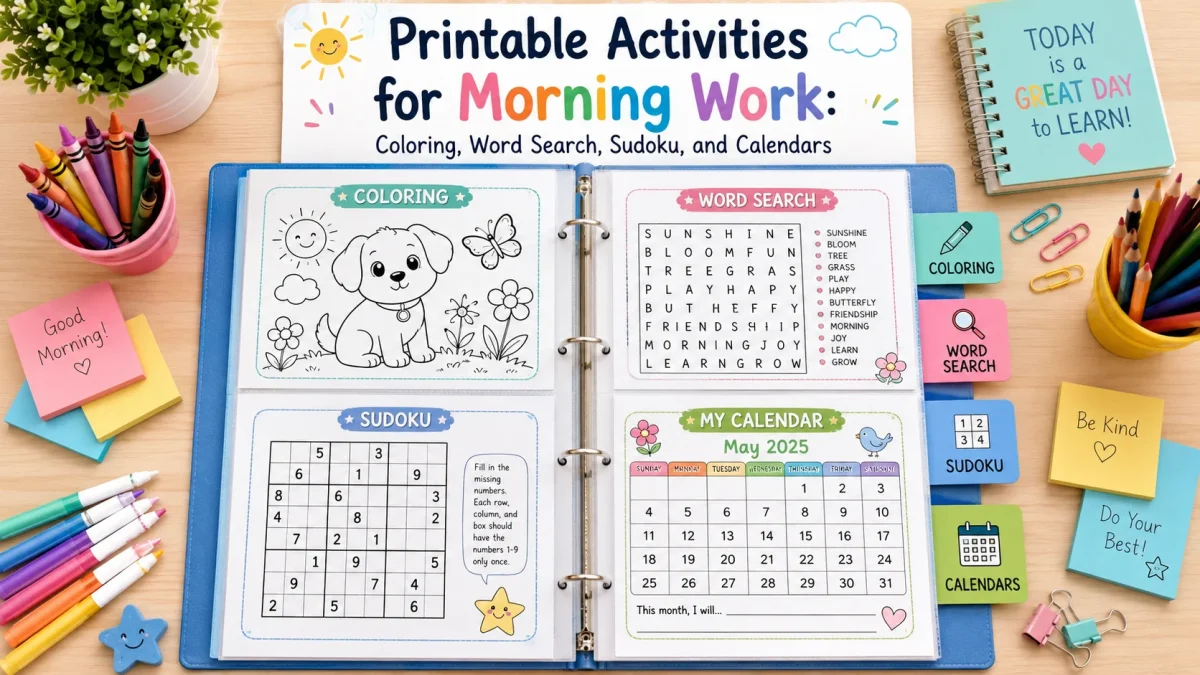
Morning work printable activities need a clear first action and a clear place to stop. A printable that students already understand can give them something manageable to begin while the class arrives. A complicated new puzzle or a long list of directions creates a different task: teaching a new activity.
This five-day routine for morning work printable activities uses a shape sheet, a familiar coloring page, a beginner Sudoku and a calendar already available in class. It is a plan with links to existing resources, not a downloadable weekly pack. Adjust the work to your group's skills and arrival window; the suggested times are planning estimates, not tested results.
What's Inside
On this page
Prepare morning work printable activities for the week
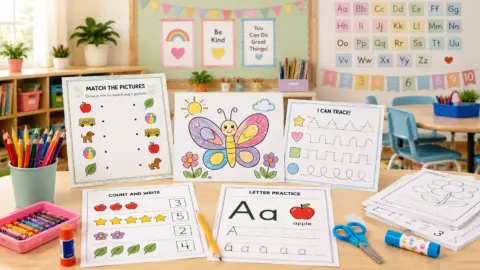
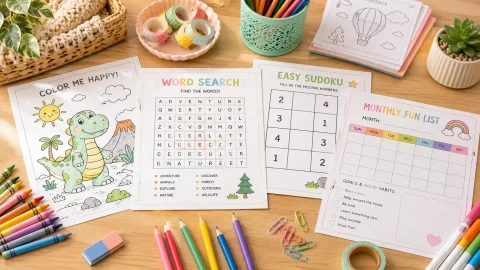
Choose a basic-shapes sheet, a subject students recognize from the coloring-page library, and a 4×4 grid from Beginner Sudoku with answers. Check the puzzle number against its answer before making copies.
For the calendar task, use a current classroom calendar or a suitable page from the printable calendars collection. Confirm the month, year and week-start arrangement before using it. A printed calendar may not include your school's closures; use your own school information for those dates.
Make five labeled folders. Put each day's student page in its folder, write the direction on a separate top copy, and keep solutions in an adult-only section. Keep morning work printable activities limited to tools the task actually uses. Students need pencils; offer crayons only when the task uses color. Print one test copy to check small text and edges before making a class set.
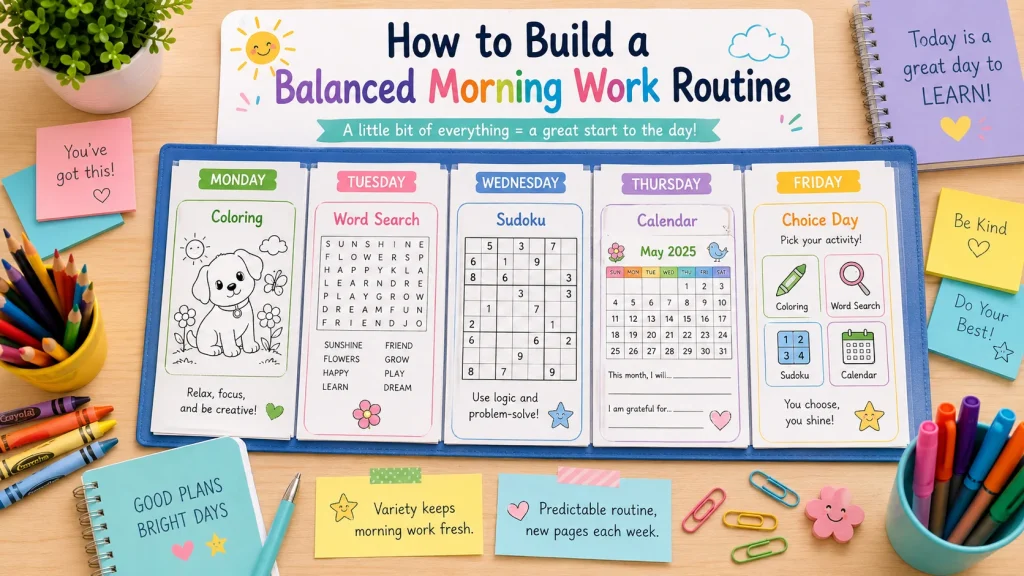
A five-day plan for morning work printable activities
| Day | Material | First action | Finish point |
|---|---|---|---|
| Monday | Basic-shapes sheet | Find and mark a triangle | Name or describe three shapes |
| Tuesday | Familiar coloring page | Look for three visible details | Give one accurate picture sentence |
| Wednesday | Familiar 4×4 Sudoku | Check one nearly complete row, column or box | Explain one move and check it |
| Thursday | Current calendar | Find today's date | Mark the next school day and one plan |
| Friday | A previously used page | Choose one unfinished or repeated task | Complete the chosen portion and reflect |
Monday: notice and name — plan for 5–8 minutes
Display: “Find a triangle. Mark it. Choose two other shapes and say or write their names.” Model the first step if the routine is new. A student who is not writing can point and answer aloud when an adult checks in.
For an extension, ask how a square and rectangle on the sheet are alike. Keep the answer tied to the visible shapes and previously taught vocabulary. Do not ask students to color the entire sheet if identifying three shapes is the intended finish point.
Tuesday: look before coloring — plan for 5–10 minutes
Display: “Look closely. Find three things in the picture. Write or tell one sentence about it.” Use a familiar subject so identifying the scene does not require a new lesson. Students who finish the observation task can color one chosen area.
Check whether the sentence describes something actually shown. Save imagined events for a separate story prompt. If a student dictates, record their words without turning the task into a handwriting assessment.
Wednesday: explain one Sudoku move — plan for 5–10 minutes
Use this task only after students have learned the rule for a 4×4 grid: use 1–4 once in each row, column and outlined 2×2 box. Display: “Find one missing number. Check its row, column and box. Explain why it fits.”
One correct, explained placement is a useful stopping point. Students may continue if there is time, but do not require a complete puzzle during a short arrival window. If Sudoku is unfamiliar, repeat Monday's shape task and introduce the puzzle later with support.
Keep the matching answer sheet away from the student pile. When checking, listen for the row, column or box that supports the choice rather than asking students to copy the solution.
Thursday: connect a date to a plan — plan for 5–8 minutes
Display: “Find today. Mark the next school day. Add one thing to remember.” Use a word or small symbol for the reminder. Check the class calendar before accepting a date as a school day, especially around weekends and holidays.
For a student who needs less writing, ask them to point to today and the next attendance day. For a student ready for more, ask how many school days remain in the week using the actual schedule. Avoid assuming every calendar is arranged Monday-first.
Friday: choose and review — plan for 5–10 minutes
Offer two familiar tasks from earlier in the week, not a large pile of new activities. Students choose one portion they can complete, then finish the sentence “I chose this because…”. An oral response is sufficient when the purpose is choosing and reflecting.
An unfinished page can return next week if the student wants to continue. It does not need to become extra work simply because the morning ended before every space was filled.
Use four consistent directions for morning work printable activities
- Unpack and collect today's page.
- Read or look at the first direction.
- Complete the named portion; use the agreed help signal if needed.
- Put the page in the finished or continue-later tray when the class moves on.
Teach the trays and help signal as part of the routine. The Institute of Education Sciences recommends explicitly modeling and practicing classroom routines and expected procedures. If students arrive at different times, make the finish point smaller for a late arrival rather than expecting the same amount of work in less time. Repeated requests for help are a reason to revise morning work printable activities, not proof that students need more worksheets.
Review morning work printable activities at the end of the week
Keep a short planning note with four headings: Started independently, Needed explanation, Used the time, and Would repeat. Record what you actually observed. For example, note that a direction needed reading aloud or that the puzzle rule needed another demonstration; do not claim a measured attention or learning improvement without evidence.
Change one feature in the morning work printable activities for the next week: shorten the instruction, choose a more familiar subject, reduce the required portion, or add a model. Keep enough of the routine stable that students do not have to relearn the procedure every morning.
For a wider choice of individual tasks, use the 25 classroom activities guide. For storage, the printable activity binder guide explains how to separate masters, student copies and answer keys.
Must morning work be graded?
Not necessarily. Decide whether the purpose is independent practice, a quick check or a transition. Tell students what you will look at so a short arrival activity does not quietly become a different assessment.
What if the activity is too difficult?
Offer a familiar alternative and teach the difficult part later. Independent arrival time is not the best moment to rely on directions or skills students have not yet learned.